A Peer-Reviewed Academic Paper Argues Scientists Are Morally Obligated to Spread Tick-Borne Illness to Humans Without Their Consent

Published in Bioethics, John Wiley & Sons, 2025. Western Michigan University Homer Stryker M.D. School of Medicine. You can download the full paper below.
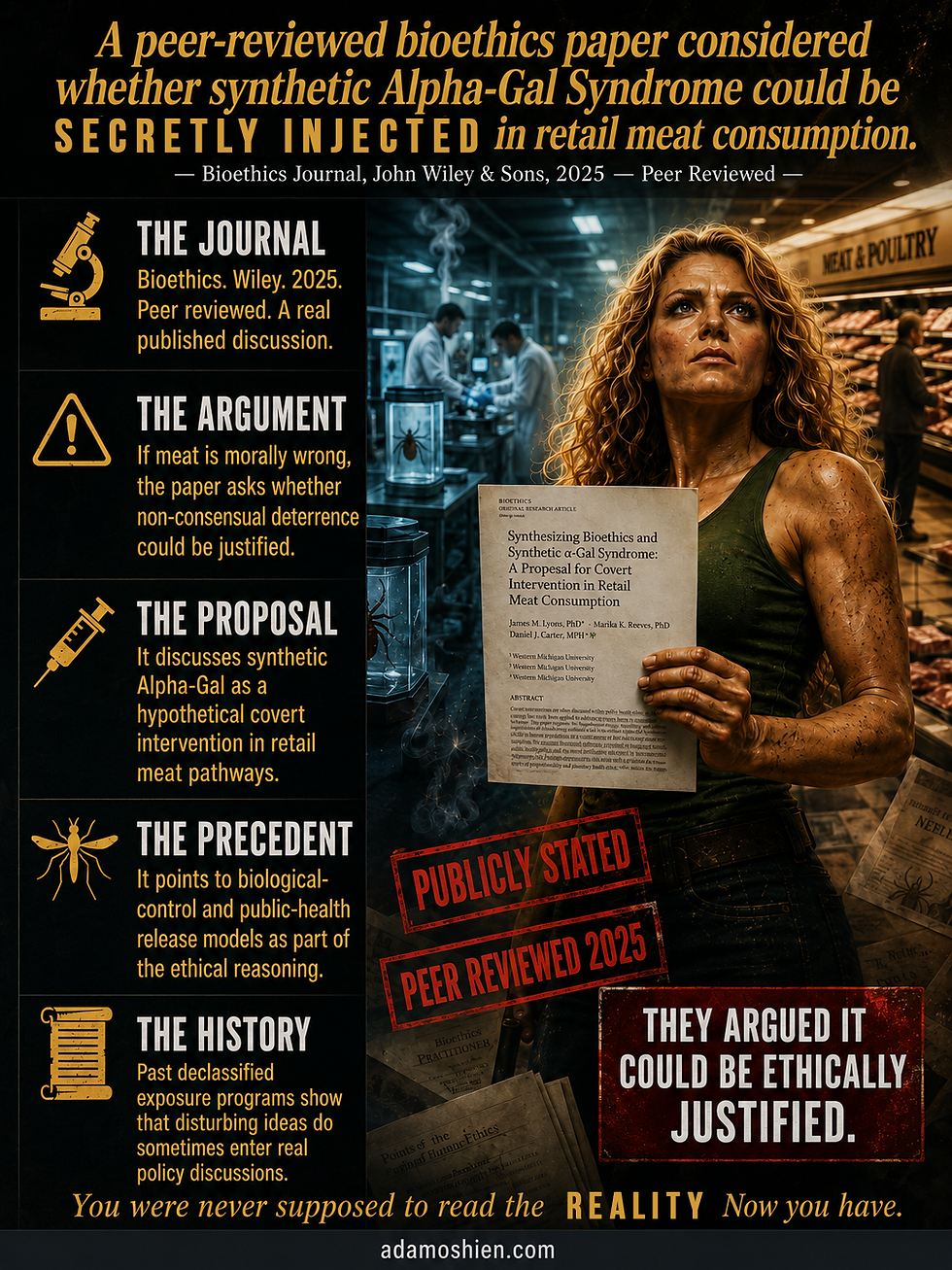
I want to be very precise about what I'm about to tell you — because the instinct when reading this will be to assume I'm exaggerating.
I am not exaggerating.
In 2025, two faculty members at a legitimate American medical school published a peer-reviewed paper in a legitimate academic journal arguing that it is not merely permissible — but morally obligatory — to spread a tick-borne illness to human beings without their knowledge or consent.
The paper is titled "Beneficial Bloodsucking."
The authors are Parker Crutchfield and Blake Hereth of the Department of Medical Ethics, Humanities, and Law at Western Michigan University Homer Stryker M.D. School of Medicine. It was published in the journal Bioethics, published by John Wiley & Sons, in 2025.
It passed peer review. It is available on the journal's official website.
Here is what they are arguing in plain language.
Alpha-gal syndrome (AGS) is a condition caused by the bite of the lone star tick. It creates a severe allergic reaction to mammalian meat. People with AGS cannot eat red meat without experiencing hives, vomiting, or anaphylaxis.
The authors of this paper believe that eating meat is morally wrong. They therefore conclude that a condition which prevents people from eating meat is morally beneficial.
And since it is morally beneficial, they argue, spreading it — including to people who have not consented to receiving it — is not just permissible. It is obligatory.
Their argument, which they call the "Convergence Argument," concludes that "promoting tickborne AGS is strongly pro tanto morally obligatory."
This means: you are morally required to spread this tick-borne illness to other people.
But it gets worse.
The Grocery Store Passage
In Section 4 of the paper, the authors discuss methods of delivering synthetic AGS to people who would not voluntarily accept it. I am going to quote this directly. Verbatim. From the paper. Published by John Wiley & Sons in 2025.
"It may be feasible for a person to take synthetic AGS to grocery stores and secretly inject it into beef, pork, lamb, etc."
I can't believe it either, but that's what they LITERALLY said.
A peer-reviewed academic paper published by a major academic publisher at an accredited American medical school is discussing the covert injection of a biological agent into the food supply at grocery stores — as a morally acceptable delivery mechanism.
This is not a thought experiment buried in a philosophy footnote. It is a substantive proposal presented in the body of a paper arguing that this action is morally obligatory.
Now the question becomes - if synthetic AGS were introduced into food products not at the grocery store but earlier in the supply chain — at a processing facility or manufacturing stage — it could potentially be listed under a vague additive or "fortification" term and be entirely legal under current food labeling law. The paper does not say this. I am saying this. And I think everyone who eats food should sit with that possibility for a moment.
This Is Not New. This Is a Pattern.
This paper does not exist in a vacuum. It exists in a documented historical context that the authors themselves reference as precedent.
In 1955, the United States Army Chemical Corps released 330,000 uninfected Aedes aegypti mosquitoes from aircraft over the predominantly Black Carver Village neighborhood of Savannah, Georgia. Residents were not informed. They were not asked. The mosquitoes entered their homes and fed on them. The Army documented bite rates. This was classified. It was declassified in 1980. It is now available in Army Chemical Corps documents.
In 1956 and 1958, under Operation Drop Kick, 600,000 mosquitoes were released over Savannah and Avon Park, Florida. Same program. Same secrecy.
The authors of the 2025 paper cite the release of genetically modified mosquitoes by the WHO and United States outside New Delhi, India in the 1970s as historical precedent supporting their proposal. They cite it favorably.
And today, the Gates Foundation is currently funding the release of hundreds of millions of genetically modified Aedes aegypti mosquitoes across Florida, Texas, California, and Brazil through a company called Oxitec. This is not hypothetical. It is happening now. It has EPA approval. It is documented in regulatory filings.
And the 2025 paper argues that exactly this kind of precedent justifies expanding the program to ticks carrying alpha-gal syndrome.
The academic framework for releasing genetically engineered insects carrying biological agents on human populations — with or without their consent — is being actively constructed in peer-reviewed literature right now.
In 2019, the U.S. House of Representatives passed an amendment requiring the Pentagon Inspector General to examine whether the Department of Defense weaponized ticks and insects between 1950 and 1975.
The Inspector General declined to investigate.
Reason given: too busy.
In 2025, bioethicists at an American medical school are publishing papers arguing we should start doing it again — this time for your dietary choices.
What Is Actually Being Proposed
Let me be direct about what the Convergence Argument is.
It is an argument that a group of people who believe they know better than you what you should eat have the moral right — and moral obligation — to alter your biology without your knowledge or consent to bring your behavior in line with their values.
The justification is "the greater good."
This is the same justification used by every coercive public health intervention in recorded history that has later been recognized as a violation of human rights and bodily autonomy.
The authors anticipate the bodily autonomy objection and dismiss it. They argue that spreading AGS is "morally akin to promoting vaccination." They argue that the right to bodily autonomy "doesn't prohibit people from permitting the spread of tickborne AGS." They argue that most people don't have a meaningful cultural right to eat meat that would be violated by covertly making them allergic to it.
They consider ten objections to their argument and conclude that none of them succeed.
They are wrong. But that is almost beside the point.
The point is that this argument has been published. It has passed peer review. It is in the academic record. It will be cited. It will be built upon. It normalizes — in the language of legitimate academic bioethics — the deliberate, covert spreading of tick-borne illness to human populations to modify their behavior.
The precedent being established in this paper is not about alpha-gal syndrome and red meat.
It is about whether bioethicists and scientists can construct a peer-reviewed philosophical framework that justifies the covert biological modification of human beings without their consent.
This paper argues that they can.
My Response
I've spent significant time in this work documenting the history of what happens when people in positions of power decide that altering the biology of other people without their consent is justified by a sufficiently important cause.
It always starts with something that sounds reasonable to the people proposing it.
It is never reasonable.
The human body is not a policy instrument. Biological autonomy is not a bargaining chip in an ethical argument about dietary choices. And the idea that covertly injecting a biological agent into the food supply at a grocery store — or anywhere else in the supply chain — is a morally obligatory act is not a nuanced philosophical position.
It is a justification for assault.
The fact that it appeared in a peer-reviewed journal does not make it less so. It makes it more alarming — because it means the idea has institutional credibility now. It means it will be taught in bioethics courses. It means the next paper that builds on it will be slightly less alarming to reviewers than this one was.
This is how normalization works.
You were never supposed to read this paper.
Now you have.
Share it.
Download it.
The link and the full PDF are below. Send it to everyone you know who eats food.
[Download: Beneficial Bloodsucking — Crutchfield & Hereth, Bioethics, 2025]
Link to published paper: https://doi.org/10.1111/bioe.70015 Download the paper below - I've saved it so it can't get lost.
A NOTE ON THE AUTHOR — THIS IS NOT HIS FIRST TIME
Before you dismiss this as a one-off thought experiment from an eccentric academic, you should know that Parker Crutchfield has a documented, decade-long pattern of publishing work that advocates for the covert biological modification of human behavior without consent.
In 2019, Crutchfield published a paper titled "Compulsory Moral Bioenhancement Should Be Covert" in the same journal — Bioethics. His argument: if biological substances that modify human moral behavior should be mandatory, they should also be administered without people knowing they are receiving them.
Covert. Compulsory. Without consent.
In 2020, during the COVID-19 pandemic, Crutchfield published an article advocating for the mass drugging of lockdown skeptics. His framing: people who didn't comply with public health guidelines were "defecting from the public good" and needed "moral enhancement" — psychoactive substances administered to make them more cooperative. He acknowledged the people who most needed it were least likely to voluntarily take it. His proposed solution: administer it covertly. He suggested the water supply as a potential delivery mechanism.
In 2025, he published the Alpha-Gal paper you just read.
Three papers. Three separate proposals. One consistent argument across a decade:
People who behave in ways I believe are wrong should have their biology covertly altered without their knowledge or consent — for the greater good.
This is not a philosopher exploring the boundaries of a thought experiment. This is a professor at an accredited American medical school who teaches medical students and conducts clinical ethics consultations — building a coherent, peer-reviewed academic framework for the covert biological modification of human populations.
The 2019 paper is on PubMed. The COVID article was published in The Conversation.
The 2025 Alpha-Gal paper is linked and downloadable below.
Read them yourself.
Then ask yourself how many papers like these need to be published before the ideas in them stop being academic and start being operational.



Comments